How to read an EPD?
Environmental Product Declaration
What is an EPD?
An EPD is a standardised, third-party verified document that summarises a product’s Life Cycle Assessment (LCA). It provides trusted data on a product’s environmental footprint across its entire life cycle—from raw material extraction and manufacturing to installation, use, and end-of-life.
To provide full transparency on the environmental impact of our products, we publish Environmental Product Declarations (EPDs) for our collections. Independently verified, these documents offer comparable data that demonstrate how we do more with less at every stage—reinforcing our commitment to closing the loop.
Confident, Conscious Choices
EPDs are especially useful for architects, designers, sustainability professionals, and anyone who wants to:
-
Make informed, responsible material choices
-
Align projects with green building certifications such as LEED, WELL, and BREEAM
-
Track embodied carbon and reduce environmental impact
Key Sections of an EPD
Understanding a product’s full environmental impact is essential for adopting a circular economy in architecture and design—and for truly closing the loop.
While EPDs are a powerful decision-making tool, they can also contain technical terms and complex data that may be challenging to interpret. That’s why we’re here to help — this page explains the key sections of an EPD, so you can use the data in the right context and with confidence.
Product Information
An EPD typically starts with 0–5 pages detailing who commissioned the document, its validity period, the declared unit, the standards applied, the programme operator, the third-party verifier, and the software and databases used for the assessment. This foundational information is crucial when comparing different EPDs to ensure you are evaluating similar documents.
Life Cycle Stages
Lifecycle impacts in an EPD are divided into modules according to the EN 15804 standard.
Each module represents a specific stage in the product’s environmental journey from resource extraction to end-of-life. By looking at these modules, you can identify where most of the impact occurs — and whether the product is truly recycled at the end of its life.
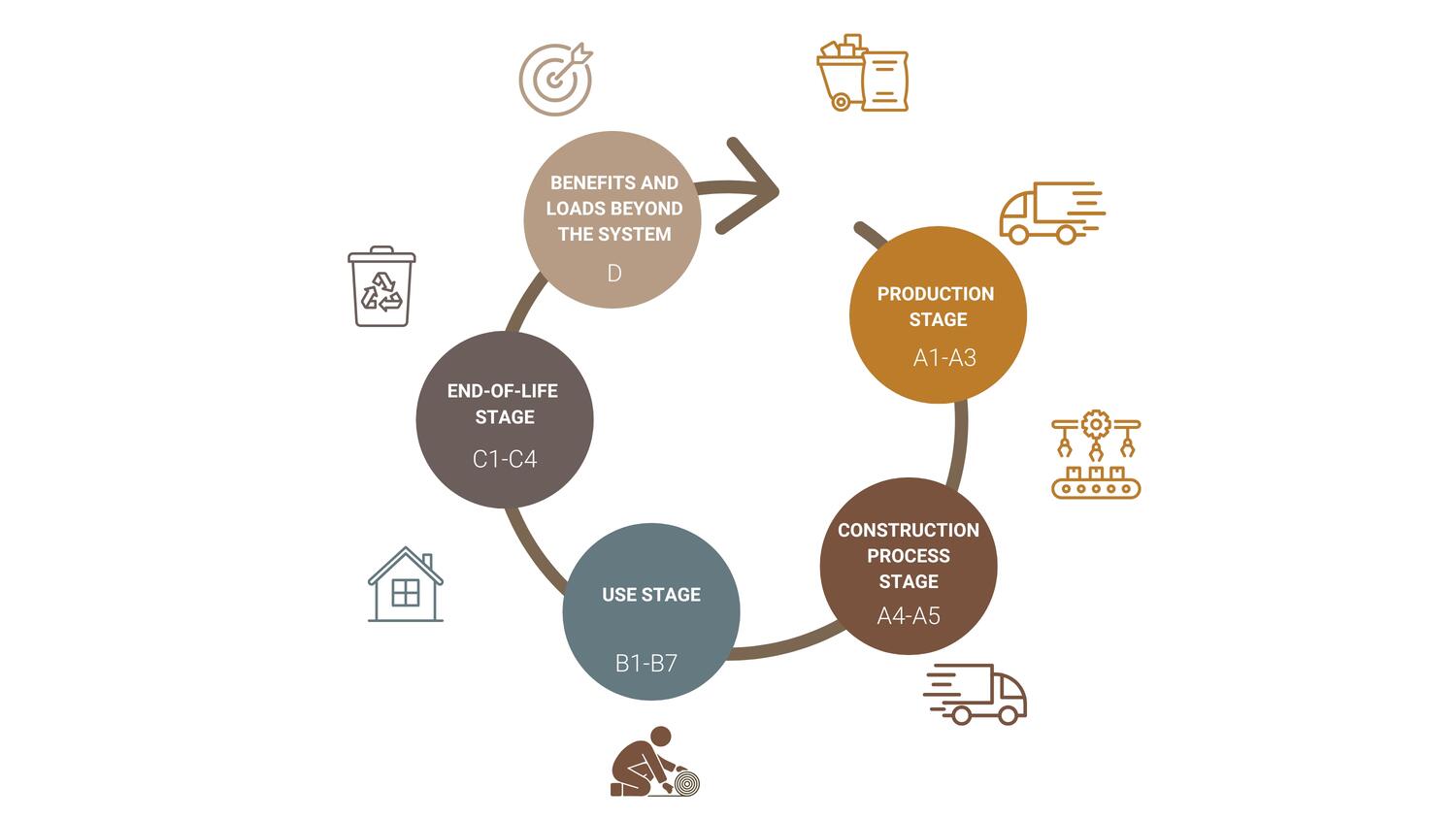
A1–A3 Raw materials, transport, and manufacturing (Product stage)
A4–A5 Transport to site and installation
B1–B7 Use phase (e.g. maintenance)
C1–C4 End-of-life (e.g. removal, sorting, recycling or disposal)
D Beyond the product’s lifecycle (e.g. recovered materials, energy gains)
- Tip: A “cradle-to-gate” EPD covers modules A1-A3 only and a “cradle-to-grave” EPD includes all stages through end-of-life (A-D).
Why the Product's End-of-Life Matters
If you are looking for a circular product, always check the end-of-life scenario (Module C). This is where you can see whether a product can be truly recycled or if it is ultimately sent to incineration, co-processing or landfill.
At Tarkett, we design our products to be circular from the start. Through our ReStart® programme, many of our products can be taken back and recycled into raw materials for the next generation of flooring.

Need help calculating the total carbon footprint of products? Contact your Tarkett representative for help
FAQ
What does CO₂e mean?
CO₂e = carbon dioxide equivalent. It expresses the climate impact of different greenhouse gases in a single unit.
What is GWP?
Global Warming Potential (GWP) measures the product’s climate impact — shown in kg CO₂e.
What’s the unit for GWP in flooring?
Usually reported as kg CO₂e per m² of flooring.
How do I read values like -5.85E-01 in an EPD?
The “E” stands for exponent (scientific notation).
• -5.85E-01 = -0.585
• 1.48E+01 = 14.8
• 6.02E+00 = 6.02
What is the End-of-Life scenario in the EPD?
Many products appear sustainable during use, but what happens at the end of their life? A product’s end-of-life scenario reveals whether its materials can be recycled or if they will end up in a landfill or incineration. Understanding this can help evaluate the product’s true long-term environmental impact.
What is the total carbon footprint, including the end-of-life scenario?
The total carbon footprint of a product includes its impact across all life stages (modules A-D), as shown in the EPD under GWP-Total or GWP in kg CO2 eq. When an EPD outlines multiple end-of-life scenarios, it means each scenario results in a different total carbon footprint. To truly assess a product's environmental impact, it's important to look beyond A1 – A3 (Cradle-to-Gate) and consider its entire lifecycle (Circular Carbon Footprint).
Why does Tarkett’s 2.5mm linoleum have a negative CO₂ value in A1–A3?
Because it contains natural raw materials that absorb CO₂ during growth. The low emissions in transport and production make the total A1–A3 impact negative: -0.585 kg CO₂e/m².
How do EPDs support green building certification?
EPDs provide verified environmental data that support credits in certifications like LEED, BREEAM, WELL, and others.
Related Content

Read more about Tarkett's programme to take back and recycle flooring materials to reintroduce them into our supply chain and make new floors.
Learn more about how you can achieve green building certifications and how Tarkett flooring can contribute
Tarkett's new thorough yet easy-to-use Carbon Calculator offers customers full transparency on the carbon footprint of Tarkett’s flooring collections